REVERSAL
From obscurity to a national power — The story of Campbell Wrestling
Josh Heil had never heard of Campbell University or its wrestling program when he got a phone call from Cary Kolat in 2016. And why would he?
The program had a combined 3-23 record in its previous two seasons and was barely a year removed from serving a one-year postseason suspension because it failed to meet Academic Progress Rate standards set forth by the NCAA. And the struggle wasn’t new — Campbell’s record in dual meets from 2004 to 2011 was a lackluster 23-118.
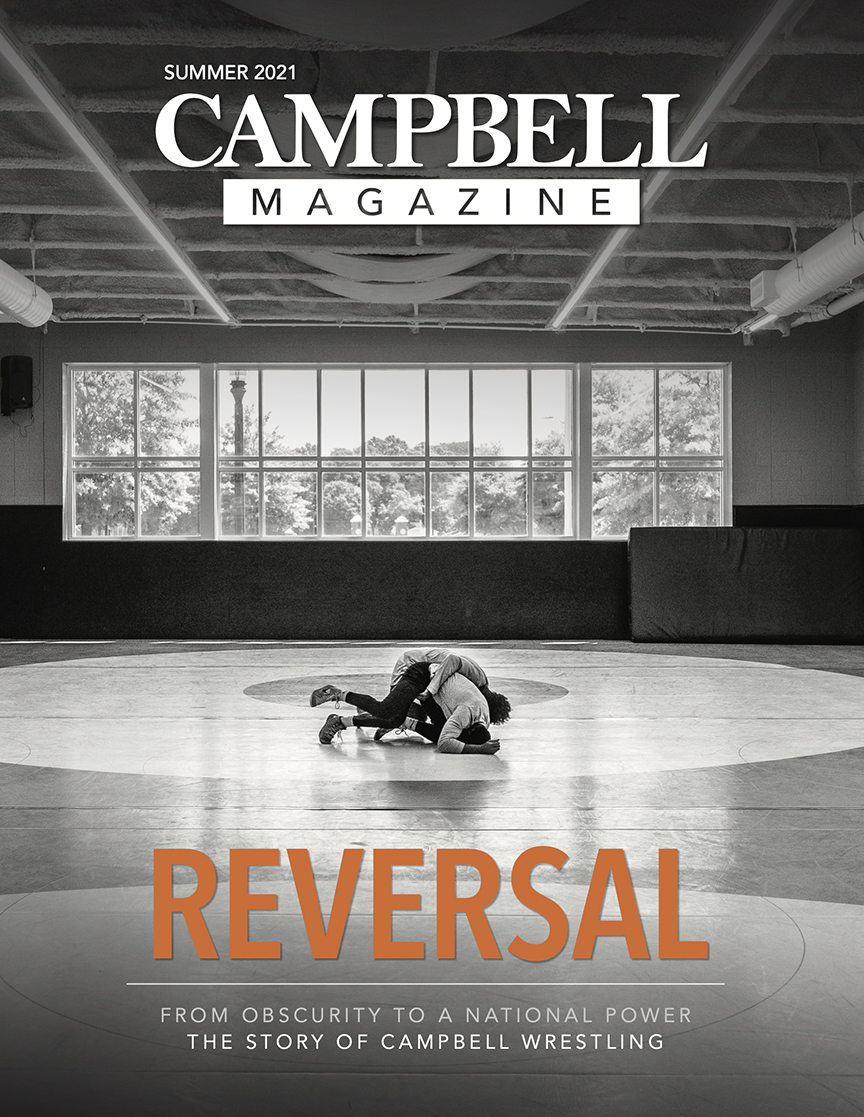
Fighting Camel Wrestling had little going for it in the fall of 2016. But it had Kolat — a former Olympian and a legend in the sport, and a name Heil and all young wrestlers knew — and it had a group of underrated and hungry young men who had bought into his vision.
So for a kid like Heil — who was short on accolades but big on potential — Campbell was a fit.
“I wasn’t what you’d call a ‘successful’ high school wrestler,” says Heil, who grew up in Ohio, a hotbed for high school wrestling. “I never won state. I never won a national tournament. I was good, but I probably wrestled at the toughest level. So for Cary Kolat to call me and talk to me the way he did — he knew I had something everyone else didn’t see. For a guy like that to think like that, it just felt right. He knew how hard I worked. He knew how hard I wrestled. And he knew that’s the kind of wrestler he wanted.”
Fast forward to 2021.
Entering his sixth year (thanks to a redshirt year and a COVID year), Josh Heil is an All-American. He’s also Campbell’s first four-time NCAA Championships qualifier, has 94 career wins (12 over opponents ranked in the Top 25 nationally in their weight class), has been ranked as high as seventh in the nation himself in the 149-pound weight class and was named an NWCA Division I Scholar All-American in 2021.
As for the program, under Kolat and current head coach Scotti Sentes — who took over in 2020 — Campbell has earned seven Southern Conference team trophies and produced 26 NCAA qualifiers and six All-Americans (including Heil) in the past five years. This past year, Campbell had a school-record seven NCAA qualifiers and two UWW Junior and Senior All-Americans and became a nationally ranked program.
Expectations are at an all-time high entering the 2021-22 season with a returning All-American and a Top 25 ranking in the NWCA Coaches Poll. More importantly for Heil, the atmosphere and swagger in the program’s recently constructed practice facility at the Pope Convocation Center is a far cry from what he experienced as a true freshman in 2016. “Six years ago, I had to trust Coach Kolat and what his plans were for the program,” he says. “We didn’t have the success that he could point to from previous years. We just had to trust him and trust his process. And that’s a big leap of faith.
“For the [freshmen] coming in now, success is expected. If you come here, and you fail, then you’re doing something wrong. But if you come here, work hard, train right, eat right, live right and follow the lead of our upperclassmen, you’re going to succeed. There’s no doubt, you’re going to win.”
Campbell’s wrestling program had its moments before the Cary Kolat era.
Founded in 1968 under the guidance of Coach Gerald Brown, the Camels put together a 6-5 record in dual matches in their first season and a 7-3 record in Year 2, going up against similarly sized schools like Wesleyan, St. Andrews, Western Carolina and Pfeiffer. The third year brought in tougher competition like Duke, the Citadel and Elon, and by the mid 1970s, Campbell wrestling was a middling program that would regularly beat up on smaller schools and regularly lose to larger, more established in-state schools.
Coach Jerry Hartman had the most successful run in the 1980s, posting an 80-39 record and bringing in kids like Bobby Sottile (107 collegiate wins against just 20 losses), Scott Amundsen (109 wins) and perhaps Campbell’s most notable wrestler in the program’s first 50 years, Anthony Cox, who became Campbell’s first wrestler to qualify twice for the NCAA Championships and missed All-American status by just one match in his junior year.
Wrestling joined the Colonial Athletic Conference in 1996 and struggled for the next four seasons against schools like Virginia Tech, William & Mary and James Madison. That changed for a short time with the arrival of former U.S. Olympic Wrestling and UCLA coach Dave Auble, who took over from 1999 to 2004 and peaked with a third-place finish in the conference in 2002. … rest of story at https://magazine.campbell.edu/articles/campbell-wrestling/?fbclid=IwAR3U-22VM1CJKM_BwcZrd-QCvDsMw06uWSiSnt3NsSat_HVIy9uE-4ErVpo
No comments yet.
TDR blog

After 20 seasons of publicizing wrestling The TakeDown Report’s (TDR) focus has changed to the collecting of college coaching records from North America since 1903. We will continue to recognize and reward successful wrestlers in eastern North Carolina (east of Raleigh & Fayetteville), assist with schools in starting or re-starting a team and this blog. Join us on our FaceBook Page – “The TakeDown Report” for photos and news. Please send results, stories, links and news to pass along. E-mail us at takedownreport@gmail.com
Martin Fleming, Editor
Takedown Report

 Takedown Report
Leave a comment